Sunday, July 31, 2016

Sunk Cost Fallacy

One time or another, we have all suffered from the Sunk Cost Fallacy. Whether it be a financial or even an emotional investment, such as relationship with another person, there are some things we just can't let go. Here, I will try to explain why.


But first, let's have a quick look at what got me thinking about this particular topic.

The character Jimmy McGill on the TV series "Better Call Saul" is far from an ordinary ambulance chasing lawyer, as we are first thought to believe. Throughout the series "Breaking Bad", in which he masterminds some of Walter White's more hair-brained schemes, he is almost seen as a pushover lawyer when he comes face-to-face with Walter's alter-ego, the infamous 'Heisenberg', doing anything to make a quick buck. This includes choosing to defend the criminals of New Mexico and networking with some very shady characters, such as Mike Ehrmantraut.

Image result for better call saul switchBut what we learn while watching the prequel series, is that Saul Goodman, or Jimmy McGill as he is known, is an extremely intelligent and perceptive con man. In the first episode of season two, after declining the job offer at Davis & Main, Kim Wexler confronts him as to why his is acting, in her mind, out of character. After putting all that time and effort into finally being recognised for his work as an attorney, she can't understand why he is throwing this great opportunity away. Jimmy explains;

'The fallacy of sunk cost… It’s what gamblers do. They throw good money after bad thinking they can turn their luck around. It’s like, “I’ve already spent this much money or time… whatever. I got to keep going!” No, there’s no reward at the end of this game.'

It is at this point, the viewer can almost read this statement as a more over-arching theme to the man Jimmy McGill later becomes, Saul Goodman. With "Better Call Saul" being a prequel series, we already know from watching Breaking Bad how his game will end. All throughout the series so far, as the main protagonist, the viewer is backing Jimmy to do well, to get the good paying job at a respected law firm to prove to his brother Chuck that he is no longer that low life con man of his past life, and for his friendship with Kim to continue to grow and evolve into a long lasting relationship. But we know it won't. As much time and effort he puts into becoming a better person, we know, and maybe somehow Jimmy also knows, that in the end it will be all for nought. After all, why deny the person he is supposed to be?

This scene made me think a little more about the term 'Sunk Cost Fallacy' and even though it is used in a economic sense, whether is can be used to describe decisions that people make every day. Unsurprisingly, I uncovered a number of psychological studies aimed at trying to understand what makes us fall for the very idea of wasting our time and effort on lost causes.

From a basic economic viewpoint, a sunk cost is an unrecoverable cost from an already incurred investment. The definition at businessdictionary.com describes a sunk cost as;

"Money already spent and permanently lost. Sunk costs are past opportunity costs that are partially (as salvage, if any) or totally irretrievable and, therefore, should be considered irrelevant to future decision making. This term is from the oil industry where the decision to abandon or operate an oil well is made on the basis of its expected cash flows and not on how much money was spent in drilling it."

A paper published by Arkes & Ayton (1999) attempted to try and understand why humans continue to honour sunk costs, while other animals, such as rats, do not. They refer to this sunk cost effect as the "Concorde Fallacy", named after the Concorde aircraft, where the governments financing the Concorde project continued to do so even when they knew ultimately the project was doomed. They did so because they have already invested a great deal of money into the project.

So, in the animal kingdom, is there any evolutionary advantage to investing in sunk costs? An example would be where a male and female produce two offspring, where one offspring is older than the other. There is a dramatic decrease in resources and keep both offspring alive and the parents must make a choice; which one do they keep alive? The newborn offspring which would take more parental investment and resources, or the older offspring that they have already invested in? According to Trivers (1972), the parents will favour the older offspring. But is this evidence of the sunk cost fallacy in lower animals? Or do the parents choose the older offspring based solely on their assumptions that the older offspring will require less resources in order to bring it to adulthood?

Another study by Weatherhead (1979) examined savannah sparrows and their defensive behaviour of their nests during their breeding season. With a short window for these birds to breed, Weatherhead studied those birds that arrived at the breeding grounds early compared to those that arrived late. Weatherhead theorised that either those birds that arrived early would defend their nests more vigorously than those that arrived later, as they had invested more time into their nests and eggs, or the birds that arrived late would defend their nests more vigorously, as the birds that arrived early would have enough time to create a new nest and lay more eggs if their first nest was attacked. What Weatherhead found was that the birds that arrived early in the breeding season, did in fact defend their nests more vigorously than those that arrived later, concluding evidence of past investment determined their behaviour.


Another experiment conducted by Lavery (1995) studied the breeding behaviour of convict cichlids, a species of fish native to Central America. Lavery compared the aggressiveness of cichlids, that had bred three time previously, to a predator, compared to fish that never bred before. The study found that the more experienced cichlids defended their brood more aggressively than those fish that had only bred for the first time. It can be concluded that this is evidence of sunk cost behaviour, as the fish which are on their fourth brood, have a much higher parental investment. But it can also be argued that the reason the less experienced fish protect their first brood less, is because they more opportunities in the future to breed again, while the more experienced fish are aware they have the potential to raise fewer broods in the future. Of course the more vigorously the fish defends their brood, the higher the risk for the fish to get injured, jeopardising the chance for the fish to continue breeding later on.
Image result for convict cichlid


So now that we've looked at the potential of the sunk cost fallacy in less evolved animals, why do humans exhibit the same sunk cost fallacy behaviour? Arkes and Blumer (1985) suggested that this is because we don't want to be seen as wasteful. They questioned;

Assume that you have spent $100 on a ticket for a weekend ski trip to Michigan. Several weeks later you buy a $50 ticket for a weekend ski trip to Wisconsin. You think you will enjoy the Wisconsin ski trip more than the Michigan ski trip. As you are putting your just purchased Wisconsin ski trip ticket in your wallet you notice that the Michigan ski trip and the Wisconsin ski trip are for the same weekend? It's too late to sell either ticket, and you cannot return either one. You must use one ticket and not the other. Which ski trip will you go on? (p. 126) 

Over half the participants who were asked this question decided they would still go on the ski trip to Michigan, because they would feel like they were wasting more money if they chose the ski trip to Wisconsin instead, even though they would enjoy it less. But is this only because we don't want to appear wasteful or is there more to it? Is it maybe because we feel like we need to justify our decisions to ourselves?

Consider this experiment by Tversky and Kahneman (1981) where they asked participants this scenario;

Imagine that you have decided to see a play where admission is $10 per ticket. As you enter the theater you discover that you have lost a $10 bill. Would you still pay $10 for a ticket for the play?

Yes (88%) No (12%) 

Imagine that you have decided to see a play and paid the admission price of $10 per ticket. As you enter the theater you discover that you have lost the ticket. The seat was not marked and the ticket cannot be recovered. Would you pay $10 for another ticket? 

Yes (46%) No (54%)

It can be concluded that people, as way of justifying not purchasing a new ticket after loosing the first one, saw their decision as simply having already assigned a value to the ticket, so believed buying another ticket at $10 would value the new ticket at $20 and too expensive.

So ultimately, why do we hold onto sunk costs, not only from a financial viewpoint but a social one too? If there is one thing we humans invest a lot in, it's time. Time we put into making our lives the way we want them with the people we want in them. It is inevitable that throughout our lives, there will naturally be people that we are drawn to and people that drift away from us. But sometimes there are those relationships where even though the relationship does not benefit either person any more, we feel like we must keep it going, because after all, just think about all that time both of you invested into the relationship. If you were to cut ties now, think about all that time you would have wasted on them. But a sunk cost is exactly that, it's sunk, and it's not recoverable. Either way, there is no way of getting your invested time back, you are only incurring more accumulative expenditure on that person.

So why do we experience the sunk cost fallacy at all? What evolutionary benefit does it have? Let's look back at the cichlids and their breeding behaviour. For the fish here, experience is the key, it's the deciding factor of how much they believe in their prior investment. So for us humans, we might be able to apply a similar idea. We fall into the sunk cost fallacy because we want our investments to succeed, even if we know they ultimately will not. But with all that time we invest, we are getting something out of it; we are gaining experience. Experience we can draw upon in the future to make better decisions. But sometimes we need to be aware of falling into the trap that a sunk cost can have us committing to, and just like the less experienced fish that look toward the future, we must remind ourselves; there are plenty more fish in the sea.

Monday, October 22, 2012

Deus Ex Machina


Deus Ex Machina” is a Latin phrase used to describe a plot device in a storyline where an unexpected power or event saves a seemingly hopeless situation. Its literal translation is “God from the Machine” but more basically means some sort of divine intervention. Its origin comes from ancient Greek and Roman theatre where playwrights would incorporate an actor descending from above the stage on ropes, representing a god, to advance a storyline, in order to provide solutions to an otherwise unsolvable scenario. Hence the translation of “God” from the “machine”, the machine being the device lowering the actor onto the stage. And I think this is an excellent way to start my next (and long overdue) entry.

***Warning: contains spoilers***

After recently completing the Mass Effect series, I have been asked on various occasions as to my overall thoughts on the ending. Before finishing the game series, I had read (while avoiding all spoilers I might add) that many people were left with a sense of emptiness and frustration when finally reaching the game’s epic conclusion. This has ultimately led to BioWare  releasing new extended versions of the choices Shepard has on offer to him. To me, while the new cut scenes finally bring about some closure by explaining a little bit more of the consequences of your actions, I feel like I actually prefer the open-endedness of the original endings. I will attempt to write my thoughts into a coherent explanation here.

But before I begin, let’s back up a bit. First we have should look at the Mass Effect plot as a whole and what story it is trying to tell. For me, it is the story of Organic and Synthetic life and the differences between the two, if there are any. If you have a look back at modern literature, there are many human and machine narratives, where ultimately humans, the creators, are in some sort of struggle with the machines, the created. On completing Mass Effect, my initial thought was how similar the story-line is to that of the Matrix trilogy.

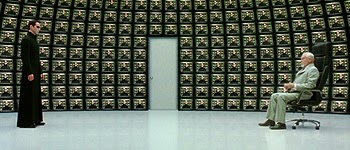
Now at first you might think that I’m stretching a bit here, but both have very correlating themes throughout, the more obvious one being that of humans v machines/synthetics. On closer analysis, the scene where Neo meets the Architect is very similar to when Shepard meets the Catalyst and similar themes are explored, that of free will and choice over purpose and destiny. The Architect explains that the Matrix which Neo is familiar with is not the first one created by the machines; in fact they have created many others before, having to eventually destroy them. This is almost identical to the Reapers and their destruction of the advanced organic races and have done so throughout many cycles of the galaxy’s history. The machines claim this is all done to save the humans from themselves of course.


Of course the machines soon discover that trying to control the humans within the Matrix has one major flaw; that is free will. Whereas the machines have been created with a purpose, humans are ultimately given a choice, as to whether they accept or reject the Matrix. Without this choice, the Matrix would fail as the humans would reject it all together. This anomaly of choice and free will eventually manifests itself in the Matrix as the One.

The machines allow this anomaly to occur as they believe they are able to control it. Thus they allow for the humans to rebel and create Zion and eventually find the One who will save humanity. But this will only complete the cycle of destruction and the creation of the next Matrix. Much like Shepard’s choice at the end of the game, Neo has a choice to make. To allow the destruction of Zion and choose 23 individuals to free from the new Matrix once the old one is deleted. Or to continue the current resistance which will ultimately lead to extermination of mankind and a complete system crash (as without the humans to power them, the machines will also be destroyed). Unlike the previous Ones before him, Neo chooses the second door much to the surprise of the Architect. So much like Commander Shepard, Neo has the choice of either ‘Control’ or ‘Destroy’, not including the third choice synthesis of course.

But what annoys me the most about the ending of Matrix Revolutions is that Neo is only successful in bringing about peace between the human and machines for an unspecified amount of time. Now I am not a huge fan of the happily-ever-after ending but I expected some sort of victory over the machines in the end. The last scene we see the Oracle, the Architect and the little girl in the park which I can only assume is the beginning of the seventh Matrix. And I can’t help feeling like all three movies have wasted my time if, in the end, nothing has really changed.


Anyway, that is a bit off topic and maybe a subject for another time. The other thing that confuses me with the Matrix trilogy is Neo’s ‘powers’ in the real world after he chooses ‘Destroy’ after speaking with the Architect. Seeing how all the other Ones before Neo had chosen ‘Control’, the consequences of such a choice on the One would be unknown to anyone, as the purpose of the One program was to return to the Source. One theory could be that what we think of as the ‘real world’ is in fact just another Matrix and another system of control. This could explain why Neo’s powers in the Matrix are now useable in the real world. The Matrix within the Matrix theory could also explain as to how Agent Smith is able to transfer is program into Bane before he gets jacked out and is then in control of him in the real world. This could easily be done if the real world was just another computer simulation.


But because this theory is never established outside fan forums, we can say, although a really interesting twist to the whole trilogy, this theory is unlikely. One idea I like is that upon making his choice, Neo was close enough to the Source (whatever the Source might be) without making the ‘Control’ choice which would have led to Neo sacrificing himself, that he has somehow evolved and can now control the machines in the real world, maybe as a result of some program integration into his human body, much like the ‘Synthesis’ choice presented to Shepard. With sacrificing himself into the Crucible, Shepard provides his DNA in order for all sentient beings to reach the next stage of evolution, that is the combination of synthetic and organic life. Maybe Neo’s powers is a result of something similar.

Now on the topic of human evolution, the ending of Mass Effect not only reminded me of the Matrix trilogy but also of a well known classic film; Stanley Kubrick’s 2001: A Space Odyssey. For those who have not seen this movie, I highly recommend you go out and buy it, download it, whatever, it is a must watch. Of course this film is not for everyone, and is less sci-fi action and more sci-fi art and parts can drag on.
But again, even though this film was first released way back in 1969, the theme of human versus machine is still ever present. HAL is the on-board spaceship’s AI that eventually turns on its masters Bowman and Poole. But although it would seem like HAL’s choice to kill the two astronauts is entirely his free will, it is still HAL fulfilling his purpose as a machine. HAL’s two directives from Command back on Earth are to communicate all information truthfully and accurately, and to keep the real purpose of their mission (to find where the signal from the monolith on the moon is transmitting to, somewhere near Jupiter) a secret from the two astronauts. In order to fulfill these two objectives without compromising the other, the only option HAL believes available to him is to kill them, thus not compromising his original programming.


Upon viewing, you will also notice the similarity between the monolith in the open sequence on Earth with the monkeys and the monolith on the Moon, and the Prothean Beacons that Shepard comes across like the one on Eden Prime.


So after destroying HAL, but not before he kills Poole, Bowman continues on to Jupiter where he finds another monolith which takes him on a psychedelic journey through space and time. On the other end of this journey, Bowman finds himself in a room, which is a construction of his subconscious, where everything is not quite what it seems. The aliens who seems to be the creators of the monoliths and as a result, they have influenced the evolution of humans from the primates we see in the opening sequence, seem to be trying to communicate to Bowman. Upon his death, he sees the monolith once more.


This leads to Bowman being ‘reborn’ as the Star Child, a giant floating fetus above Earth which I interpret as Bowman reaching the next stage of human evolution, with a little help from the unseen aliens of course.


So where most people seemed to be underwhelmed by the eventual ending to the Mass Effect series, I felt that it was just another contribution to the ongoing discovery of our own evolution and our ever increasing and rapid development of our technology. It only seems inevitable that we as a species will eventually create artificial intelligence which leaves us with the ultimate philosophical predicament; what defines life?

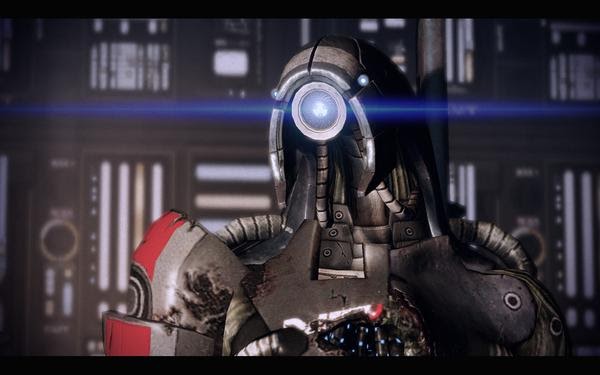
One of the best examples of this question is Shepard’s conversations with Legion and EDI. During one conversation with Legion, the question of whether the Geth have “souls” or not is discussed. If EDI “truly feels alive”, then what is to say that she doesn’t have a soul? As AIs, both EDI and Legion can think for themselves and make their own decisions, but to what degree? Do they have free will as Shepard and other organics have? Or are they still acting upon an original purpose?

For me, the most difficult decision was reaching the end of the Geth/Quarian storyline arch where you must choose between which race dies and lives (if you have completed certain missions in Mass Effect 2 with a specific outcome, you can save both). Legion again asks you “Does this unit have a soul?” If this decision was given to you in the first game, the decision would be easy and you would likely choose the Quarians, as you only encounter the Geth as mindless drones. But at this point in time, Shepard must make a difficult decision. If the Geth truly have souls, are they not more than just machines, pieces of hardware and software, are they not also alive, just as much as the Quarians?


The ultimate difference here is purpose versus free will. As humans, our entire civilization is based on discovering our purpose and place in the Universe; what is the meaning of life? Synthetics on the other hand are created with that purpose already built into them. It is when a synthetic chooses, out of free will, to either ignore or fulfill that purpose that it truly becomes alive. But in saying that, does that mean the Reapers are not truly alive, as they are under the control of the Catalyst and are only fulfilling their purpose by harvesting and eradicating advanced organic life. Then to extend that thought, is the Catalyst alive as it is the one controlling the Reapers. Only with the Crucible is the Catalyst able to deviate from its purpose by offering Shepard his three options of Control, Destroy or Synthesis.


This then brings me to my last point. Unlike other games, there is no big bad boss to defeat at the end but a philosophical choice as to the best way to save the galaxy from the Reapers. This can be seen as the Deus Ex Machina solution to the Reaper conundrum. Here Shepard is given the task of only having to choose one of three options, by the literal God (the Catalyst) in the Machine (the Crucible). And the Synthesis option given to Shepard seems to be the logical solution to the unsolvable problem. Here he can stop the cycle and in doing so, he can achieve the evolution of mankind, by molding organic and synthetic life forms together. Is this the very meaning of life we have been searching for, being in control of our own destiny and our own evolution with the power of our own creations? Only time will tell.

Tuesday, July 12, 2011

The Carbon Tax

This blog entry is a bit 'off topic' to my other posts but I thought to include it as it's a pretty big issue right now and is something I feel strongly about. For those that don't know, I wrote my final year project at RMIT University back in '08 about the impact an Emissions Trading Scheme on the Aviation industry in Australia.

Here is a summary of the relevant conclusions that I made;

"There is enough scientific evidence to conclude that there is a steady increase in global temperatures as a result of global warming. This global warming has been linked with greenhouse gases, mainly man-made carbon emissions. Countries, mainly from Europe, have committed resources to reduce these man-made carbon emissions in order to stop the rise of global warming. This was the main purpose behind the Kyoto Protocol, to bring understanding and action towards climate change on an international scale."
  • It is still being debated whether man-made carbon emissions have much impact on global warming at all. Either way, I would still prefer to live in a world with clean air, wouldn't you?
"One of the first items that the new Rudd Government addressed once taking office was to ratify the Kyoto Protocol. This is because Australia will be one of the most effected countries if average global temperatures were to rise. The IPCC estimated that by 2070 these temperatures could rise by 5 degrees but also estimated that a rise of 3 degrees would greatly damage Australia’s natural ecosystems and ultimately Australia’s industries. Australia is highly dependent on natural resources and any impact on them would greatly influence the industries, mostly the agricultural industry. This is because as temperatures rise there is less rainfall, meaning that farm land becomes drier and more difficult to cultivate crops and raise livestock. Australia is a large exporter and any dramatic decrease in the availability of these goods and services would deeply affect the nation's economic growth" 
  • All the people complaining about the rise in prices of goods because of a carbon tax really need to take a step back and think about the bigger picture here. With or without a carbon tax, these prices are going to increase regardless, especially food, as supply decreases because of availability of these resources, demand increases and so does the price. It's basic economics.
"An Emissions Trading Scheme should be operating along side other similar systems worldwide. The criticism to this is that when other countries like the United States and Japan implement their own Emissions Trading Scheme that it will still come short of half of global emissions, while countries without such a system will continue to increase their emissions. This is why it is important that Australia adopt an Emissions Trading Scheme in order to help positively influence other countries in the Asian region such as China and India, some of the world’s largest polluters."

  • There are a lot of people out there arguing that Australia cutting down its carbon emissions will not reduce the overall carbon emissions of the planet significantly enough to warrant a carbon tax. Yes, Australia only produces a small percentage of the world's carbon emissions but if we start thinking outside our borders and take take steps to 'positively influence' those big polluting countries. Just think of our international standing if we are at the forefront of green energy solutions, and selling these new technologies to these other countries.
There are too many people seeing this carbon tax as just another tax. I do believe that an Emissions Trading Scheme would be more beneficial economically (and I do believe the Government's plan is to eventually switch to an ETS in the future) and remove the word "tax" that so many people hate. It should be viewed more as a tool to change the population's mind set. Unlike most other taxes, it's not there to increase the Government's revenue but to help people save money and make them more aware of energy consumption. If the cost of your electricity bill goes up, find ways of using less power in your home.

There is a financial incentive for companies there too. If two companies have two identical products and use the same amount of carbon emissions to produce them, then the cost of both products will increase. This creates a sort of "game theory" situation. However, if one of those companies finds a 'greener' way of producing that product, their production costs will decrease, and decrease the cost of the product to the consumer. When the consumer walks into the store and sees two identical products but one is cheaper, which one do you think the consumer will buy? This will give the company an advantage over it's competitor in terms of a larger market share.

It has also been argued that taxing companies more as a result of their carbon emissions will force them to reduce their costs which will result in job losses. This might be true, but as long as the Government encourages the pursuit of green energy, this will actually create more jobs in an entirely new sector of the economy.

People are too quick to dismiss the carbon tax before it even begins. Let's try it out, see how it goes. From what I have been reading, those households that it will affect, can expect an increase of around $400 a year. Yes, that seems a lot, but that's just over only $1 a day. And if you find ways of decreasing your household energy consumption, the actual real effect it will have on you will be next to nothing. I, for one, am more than happy to pay this extra cost in living, as the consequences of ever increasing man-made carbon emissions and inevitable global warming is just unacceptable.

Sunday, May 8, 2011

Harmony of the Spheres

Pythagoras is mostly known for his contribution to mathematics and science but he was also a very religious and spiritual philosopher. Although none of his original writings have survived, what we do know about him comes from his disciples and his ideas went on to strongly influence other well-known philosophers, such as Plato and Aristotle. It was his belief that through mathematics, one can gain an insight in the workings of the mind of God so many of his mathematical and scientific discoveries, he attributed to his pursuit of finding God.

He believed that certain shapes made up the Universe, where the circle best represents God; singular, perfectly shaped, symmetrical and with no visible start or end. Any two objects, no matter where they are placed, can be connected to form a circle, where the distance between the two objects forms the diameter. To Pythagoras, this represented man's connection with God.

He also believed that on a more spiritual level, the Universe was made up of triangles, where even a triangle can form a circle. The most basic example of this is in trigonometry, when calculating the tangent, sin or cosine of a triangle.

Circles can also be used to create an equilateral triangle (a triangle with equal side lengths and equal angles of 60° each) by joining the two circles together so that one circle's centre touches the other circle's circumference and vice versa.
The "vesica pisces" was derived from these two circles by Pythagoras, to create the fish symbol that was later adopted by the Christians.

Pythagoras and the vesica pisces even make their way into the Bible. In the Gospel of John (21:11), Jesus is said to have caught 153 fish, which to many may have no significant meaning and almost seems like a random number. But Pythagoras had calculated the length and width ratio of the fish shape to be 265:153, which is also an approximation of the square root of 3.

Here's another interesting trick. If you take any number that is divisible by 3 (15, 18 ,21 etc) and add the cube of each digit, you will eventually get the number 153.

For example, the number 18:
(1x1x1) + (8x8x8) = 513, then
(5x5x5) + (1x1x1) + (3x3x3) = 153

Pythagoras believed that the Universe was made up of numbers using circles and triangles and that each number had its own spiritual and mystical meaning. These numbers can be found using the same circle technique.

The Monad - represents the number 1 and also God, the first being

The Dyad - represents the number 2 and the individual and diversity

The Triad - represents the number 3 and harmony, justice and perfection

The Tetrad - represents the number 4 and the four elements

The Pentrad - represents the number 5 and the soul

The Decad - represents the number 10 and the Universe, heaven and Earth and is the perfect number
All of these shapes can be formed to create the Tetractys, which represent different planes and also forms an equilateral triangle, and is the founding idea of the decimal system (1 + 2 + 3 + 4 = 10)

- The first line or plane contains just the one dot. This represents the Monad, or God.

- The second plane contains two dots. This represents the Dyad the man and the woman, harmony and diversity

- The third plane contains three dots. This represents the Triad (justice), the Pentad (life) and the Hexad (psyche)

- The fourth plane contains four dots. This represents the four elements.

Pythagoras attempted to apply this idea of "perfection" to explain the workings of the Universe. He even tried to apply it to the movement of the Sun, the Earth and the planets. Pythagoras was also a musician and he believed that the distance between the "heavenly bodies" and the Earth and themselves, corresponded with a particular harmonic lengths and intervals, which if could be heard, would create a musical harmony. This is known as the "Harmony of the Spheres"

Going back to trigonometry briefly, the sine and cosine of a triangle can be drawn graphically as a wave, much like the wave of light or sound.

So theoretically, all circles, and spheres for that matter, can be drawn graphically as shown above, where a larger sphere would have a larger amplitude and therefore would produce a much lower pitched sound, or note, whereas a smaller sphere would create a smaller amplitude and cycle and would have a much higher pitch.

It was Pythagoras' idea that when all the celestial bodies of the solar system would be able to produce their own unique tune depending on their size, together creating a sort of song, all in perfect harmony with each other. Of course, he never intended for this idea to be taken literally.

But what if the planets and stars could be heard? Have you ever wondered where the static noise of an untuned radio or television comes from? It comes from space. It's called Cosmic Microwave Background Radiation and is the remnants of the Big Bang. So, is what we're listening to when we hear this static just random chaos or is it the Universe's own unique song we are yet to fully understand?

Saturday, February 5, 2011

Philosophy of Ignorance

Science versus religion is always going to lead to heated debates, particularly when it involves people either side of the fence who are very passionate about their beliefs.

But throughout history, even though there is such a divide today, science and religion were closely linked. In fact, many of the great mathematicians and scientists attributed their discoveries to understanding God, and that to understand mathematics was to understand the mind of God.

The following video clip is, once again, Dr Neil deGrasse Tyson, talking about "Intelligent Design". If you have a spare 30mins to watch it, I do recommend it, but I will break it down to the main points here.


One of his main points that I really like, is his idea that religion is just a philosophy of ignorance, that it's not necessarily strictly "science versus religion" but they both make up a certain percentage of our understanding of the universe. At the point where our knowledge stops, that's where we attribute those things that we don't understand to God, and most of the great minds of the past two thousand years have done the same.

There are some points that Dr Tyson does not cover in this lecture, so I'm going to start back in Ancient Greece. The scientists of the day were not anti-religious, in fact they were very devoted followers and their pursuit of understanding was their way of getting closer to God. Their understanding was that God is rational and perfect in every way, and so the universe too must be both rational and perfect.

Two very important philosophers in Ancient Greece that begun this trend of thinking was Socrates and his student Plato. It was Plato that believed that to study mathematics was to study the mind of God, because mathematics had order, was always consistent and was completely independent of other influences.

This is a time when the Pythagorean Paradigm was a large contributing factor to the progress of science, essentially the idea of common sense and understanding the universe through precise observations. This meant that it was generally believed that the Earth was at the centre of the universe and that the sun, moon and planets had perfectly circular orbits and perfectly uniform speeds, because after all, if God is perfect, why would he not create a perfect universe?

Their reasoning behind these thoughts came from the idea that Earth is separate from the Heavens, that the stars, the forever bright lights in the sky, never changed while the Earth is made of rock, sand and soil and was always undergoing change. Logic also told them that the Earth could not be moving as birds in the sky, along with other objects, were not left behind as the Earth moved through space.

I don't really want to talk too much about the different models of the solar system used throughout history, as that is not really my point of this post. Basically, following Socrates and Plato came Aristotle and then Ptoelmy as they continued to try to explain the workings of the universe using geocentric (Earth-centred) universe, with each of them adding an increased understanding on top of previous ideas.


It wasn't until the 16th century, at the time of the Renaissance, that these ideas began to change. Nicolaus Copernicus believed that Ptolemy's model of the solar system was too complicated, something God would not allow. He also believed that the Sun is essentially God, the creator of life in the solar system, and so should be placed at the centre (heliocentric model).


Interestingly, another scientist and astronomer at this time, Tycho Brahe, believed that Copernicus was wrong because with the Sun at the centre, he calculated that the stars would have to be 700 times further away from Saturn than Saturn is from the Sun, and he believed that God would not waste so much space. It is now known that distance from Saturn to the nearest star is in fact 28,500 time further away than Saturn is from the Sun.

Then Galileo came along with his telescope and made some significant discoveries, including the four moons orbiting Jupiter, which proved that not every object in the sky orbits around Earth, and that Venus does orbit around the Sun. Obviously, this idea of a heliocentric universe went against the Church and its teachings. That is not to say that Galileo did not believe in God, in fact he was very religious, but his reasoning was that he believed his ideas gave a better understanding on how God worked and he wanted to help more common people understand how the universe, and thus God, worked.

Johaness Kepler then came along and, using Copernicus' heliocentric model, discovered the laws of planetary motion, i.e. the orbits of the planet around the sun.

Essentially, Dr Tyson's main argument here is that after a certain level of discovery and understanding, there comes a point where we can't explain the universe anymore and that's when people, including the more scientifically aware, begin turning to a more "faith-based" approach. All of these "great minds" eventually, after reaching the limit of their knowledge, turn to Intelligent Design to explain the unexplainable. That is until someone else comes along and decides that it isn't unexplainable and without taking the easy way out by invoking God, sits down to solve the problem, which progresses our understanding of the universe.

He quotes a percentage that from a study that 85% of an "elite" scientists reject a personal god and thus Intelligent Design. But that still means 15% of our "great minds" TODAY still believe in a personal god. So what hope do the general public have?

But he doesn't argue that we should stop teaching the theory of Intelligent Design, in fact the opposite, as both science and religion, throughout history, go hand-in-hand, and what better way to understand the way the human brain works than to try and understand why some people believe in the things they do.

"I'm not going to say 'don't teach this' because it's real, it happened. So I don't want people to sweep it under the rug because if you do you're neglecting something fundamental that is going on in people's minds when they confront things they don't understand"

It is the battle between ignorance and understanding that makes us human.